
Discreet protective and residential support in Cobham. Coverage is shaped by a training ground that brings recognisable households to the village on short contracts, an international school population, and a road junction that has been under works for years.
Cobham is a village that became something else after 2007, when a Premier League club opened its training centre on the fields at Stoke d'Abernon. Players and coaching staff followed, and with them a market for very large houses on the private roads of the Fairmile, Eaton Park, Oxshott Way and Leigh Hill, where new builds behind electric gates now outnumber the older houses they replaced. The other population is international. The ACS campus on Portsmouth Road draws families posted to London for a few years, who rent or buy near the school and leave again, and Reed's, Feltonfleet and Parkside add a domestic intake. The village centre is a short High Street beside the River Mole, with the working watermill at one end and the Tilt behind it. Painshill's landscape garden sits to the west. What gives the place its particular character is the road. The A3 passes the village and meets the M25 at junction 10, a junction that has been rebuilt over several years, so a journey to Heathrow, Gatwick or London begins with the least predictable mile in Surrey. The station at Stoke d'Abernon gives around forty minutes to Waterloo.
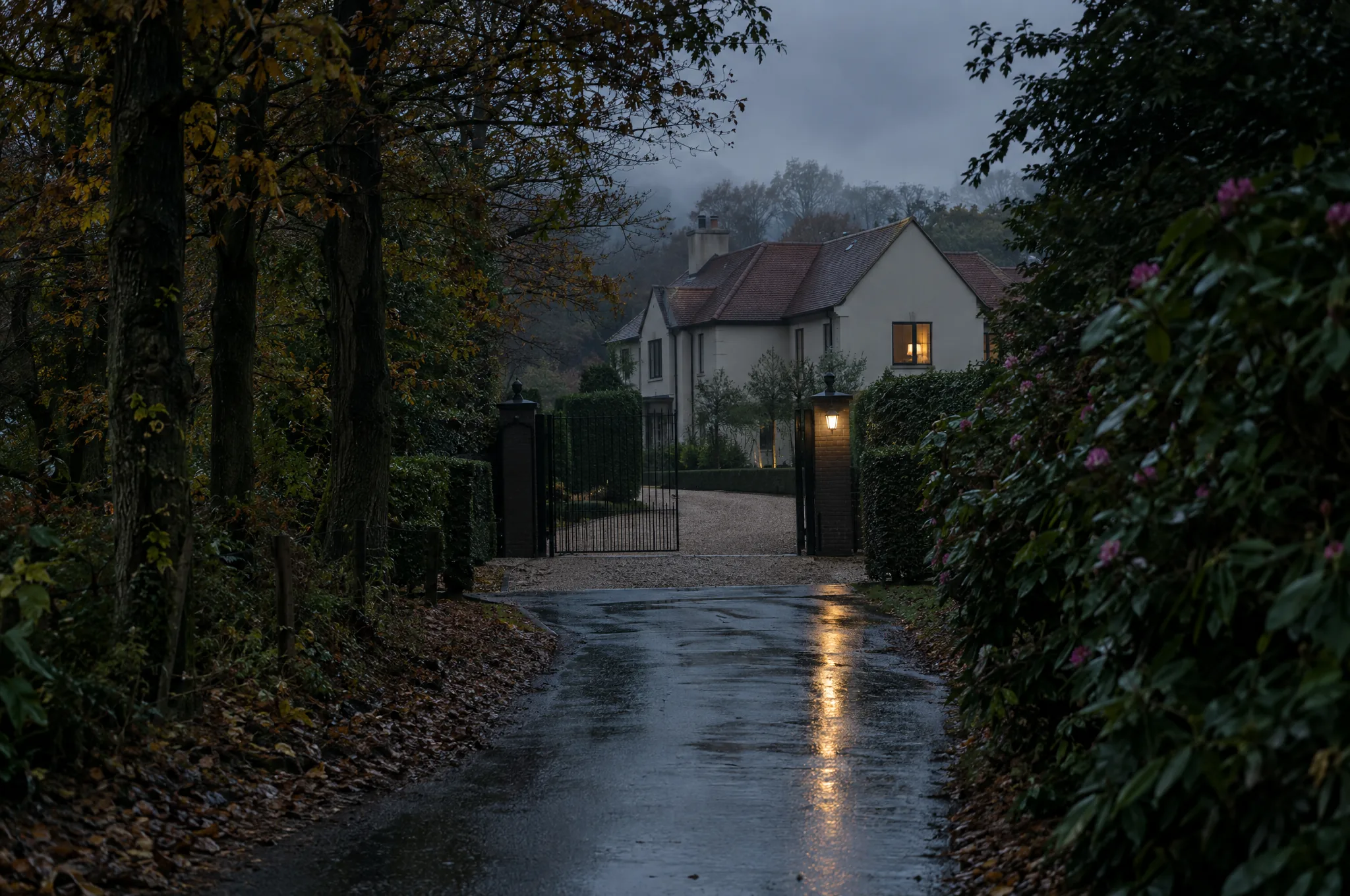
In Cobham we plan for profile and for turnover. Many of our principals here are recognised on sight, which makes concealment impossible and discretion more important, so we work on where the household is seen rather than on whether it is. Arrival is the first piece of work: a family new to the country, a house bought or rented in a hurry, staff engaged through an agent and a car on order all arrive in the same fortnight, and the household's exposure is highest before anyone has thought about it. We assess the residence and the routes together, because in Cobham the gate opens onto a road network that funnels everything through the same junction. For principals who travel with a club we coordinate with the club's arrangements without duplicating them, covering the family and the house when the principal is away. Our presence is single and low profile. A visible team in a village this size becomes a story within a week.
Executive Protection accompanies players, coaching staff and business owners from the Stoke d'Abernon training ground into the village with one officer nobody registers.
Residential Protection is most often arranged for a house on the Fairmile, Eaton Park or Oxshott Way estates within weeks of a family arriving.
Threat and Risk Mitigation measures what a household gives away when its principal is photographed weekly, its address is discussed locally and its children's school is known.
Cobham households arrive quickly and often leave quickly. A transfer is agreed, a house is found on the Fairmile within the week, and a family with a public profile is living behind a new gate before the alarm has been commissioned.
Recognition is the standing condition. A player is known in the High Street, at the school gate and at the petrol station, and so are the car and the children. Anonymity is not available. What can be managed is whether the pattern of the week can be read by someone who wants to.
The private roads are good at one thing. They keep casual traffic out. They do less about the photographer with a long lens on the public lane behind the plot, or the delivery driver who has now been to the house four times.
The junction shapes every journey. Lane closures, overnight works and diversions at junction 10 change the route to the airports and to London from one week to the next, which removes some predictability and adds a great deal of time sitting still in traffic in a recognisable car.
International families bring a different requirement: a household with no local knowledge, no established contractors and no one to ask. Much of the early work is simply orientation.
The neighbouring village of Oxshott shares the school run and several of the same estates, and Esher lies on the road to London. The county picture is set out under Surrey.

The football calendar governs. Transfer windows in January and the summer bring arrivals, departures and press interest to specific houses. Match days empty the house of the principal and fill it with visitors, and away fixtures, European nights and international breaks leave the family alone for days at a stretch.
The academic year matters as much. Term starts bring a new intake of international families in August and September, many of them in the country for the first time.
Summer weekends draw visitors to Painshill and to the river, and the roads through the village slow.
Junction works run to their own timetable and are published, and travel around closures is planned rather than discovered, with the longer runs to Heathrow and Gatwick covered under secure movement across Surrey.

The most common request is protection for a recognisable principal and the family around him, arranged through an agent, a club liaison or a private office and needed within days. That work draws on executive protection as its core, with the residence and the routine brought in from the start.
Residential assessments come next, usually of a house the family has just taken and knows nothing about, including who has held keys during the sale or the void.
A technical surveillance examination of a rented or newly purchased house is requested before the family moves in, and again when an agent's contractors have been through it.
Secure movement covers the airports above all, then London and the school run.
International families ask for orientation as much as protection: which contractors to trust, how the estate works, what is normal here.
Private offices ask for a threat and profile assessment when a principal's public standing changes, in either direction.

All enquiries are handled discreetly and reviewed before engagement suitability is determined. Information should be limited to what is necessary to outline the matter. Where appropriate, further contact is arranged following review.

Protect
Executive ProtectionDiscreet, intelligence led executive protection for private clients, principals and families, designed to reduce exposure and preserve freedom of movement without unnecessary visible presence.

Mitigate
Threat and Risk MitigationStructured assessment that identifies where exposure exists and reduces it through proportionate, targeted measures across people, places and routine.

Detect
Surveillance DetectionSurveillance detection identifies hostile interest and emerging patterns of activity, providing early warning of potential threats before targeting progresses to action.
Sweep
Technical SurveillanceTechnical surveillance that detects covert devices, unauthorised transmissions and technical compromise across residences, offices and sensitive environments.

Secure
Security ChauffeuringSecure movement delivered through trained protective drivers, considered route planning and continuous situational awareness.

Fortify
Residential ProtectionResidential protection for private homes and estates, drawing on assessment, access control and continuity to protect principals and families at home.

Respond
Close Proximity Response™A discreet, client carried alert and live location capability that lets a protective team maintain proximity and respond immediately, without an overt security presence.