
Security chauffeuring across Surrey for principals commuting into London, planned around gated estates, long private approaches and a fixed daily pattern.
Surrey is the heart of the stockbroker belt, a band of established affluence running through Cobham, Weybridge, Esher, Oxshott and Virginia Water. Large private houses sit within gated estates such as St George's Hill and the Wentworth Estate, reached by long drives and screened from the road. Finance principals, business owners and high net worth families live here alongside golf courses and private schools.
The defining feature of movement in Surrey is the commute. A principal leaves a known address at close to the same time each weekday, joins the same handful of roads, and arrives at a known office in London. There are only so many ways out of a gated estate and only so many routes into the capital, and the journey repeats several hundred times a year.
That regularity is the exposure. The vulnerable points are the ones the principal cannot vary: the estate gate, the approach road, the point at which a private drive meets a public one, and the arrival at the London end. Each is a fixed location at a broadly fixed time, observable from public ground, with no requirement for anyone to enter the property at all.
The journey is also long enough that a vehicle following it is not conspicuous, and quiet enough at either end that one which is following becomes visible to a driver who is looking.
Private estates, schools and airport runs each shape the requirement differently, and our coverage of Surrey takes them separately.
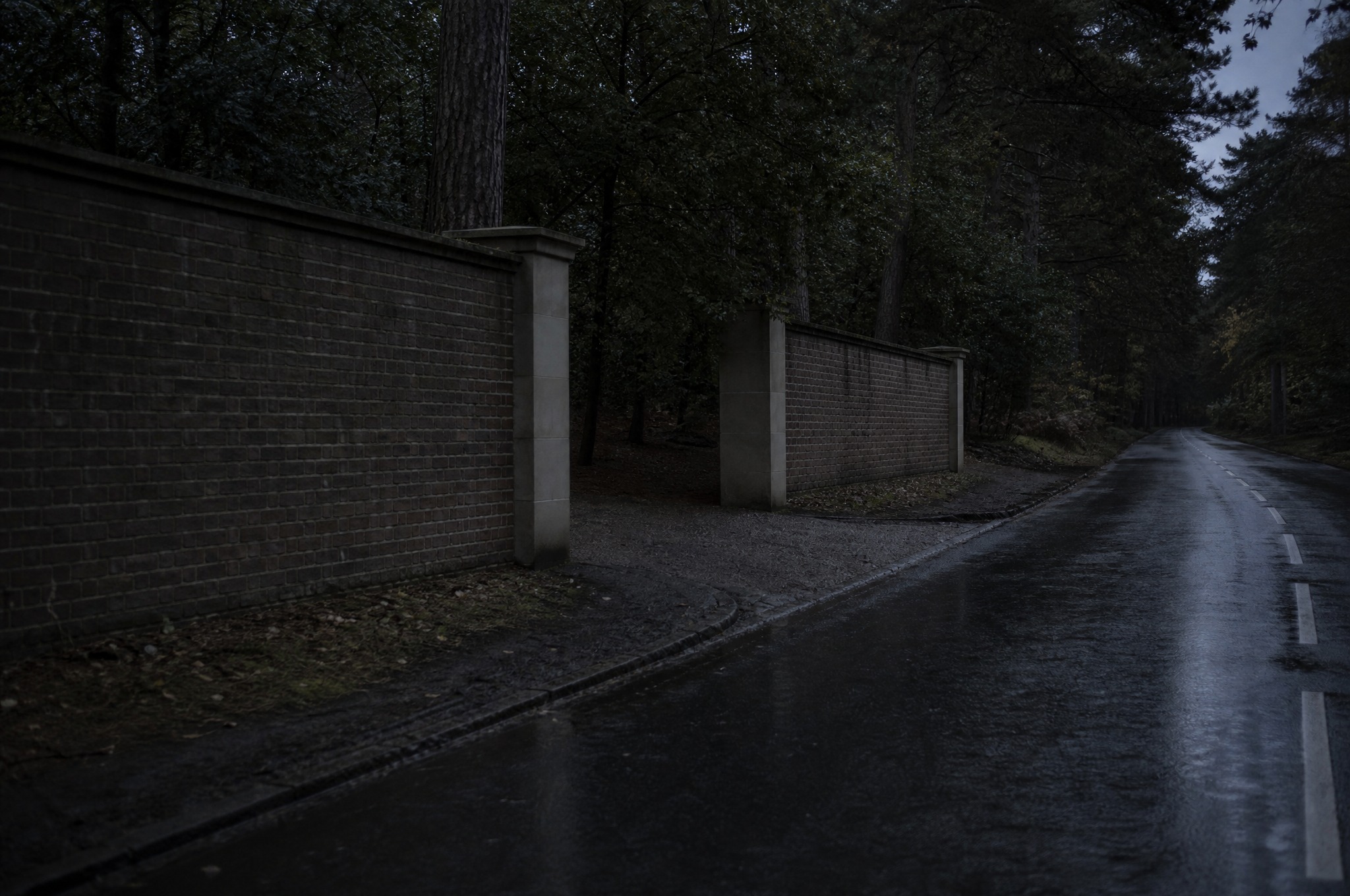
Security chauffeuring in Surrey is built around varying what can be varied and covering what cannot. The estate gate and the London arrival are largely fixed. The route between them, the departure time within a workable window, and the sequence in which roads are used are not, and disciplined variation across those removes most of the pattern that makes the commute predictable.
Drivers are trained to observe rather than merely to drive. On a route this repetitive, a driver who covers the same ground daily is the household's most effective early indicator, because they are the person best placed to notice the vehicle that is present twice in a week and did not used to be. That observation is recorded and reviewed rather than left as an impression.
The private approach is planned as carefully as the public road. Long drives and gated entrances create a slow, enclosed and predictable moment at the start and end of every journey, and the arrangements at the gate, including how it is opened, how long the vehicle waits and what the driver can see while waiting, are addressed directly.
Where a household runs several journeys, the school run and the commute are planned together, since they usually share the same gate within the same hour and are frequently treated as unrelated.
The standard is the same security chauffeuring standard applied in central London, with the difference that a Surrey journey is longer, faster and much harder to vary.
The assessment covers three things: the estate gate, the route, and the driver.
At the gate we establish how it operates, how long the vehicle is stationary while it opens, what the driver can see from that position, whether the approach can be observed from the public road, and whether an alternative exit exists. On a gated estate this is the most constrained moment of the day and it repeats twice daily for years.
The route is then mapped for genuine alternatives rather than nominal ones. Between a Surrey estate and central London there are usually three or four workable variations, and the assessment establishes which are realistic in each direction at the relevant hour, so that variation is a plan rather than an improvisation.
The driver is assessed and briefed as an observer. We establish what normal looks like on each segment of the route, and put in place a simple record so that a vehicle noticed twice in a week is written down rather than half remembered. Over a commute repeated several hundred times a year, that record is the most useful detection the household has.
Where the household runs a school run as well, both journeys are assessed together.
Gates, drives and delivery access frequently matter more than the road itself, which places the finding under residential protection.

The commute is the constant and the variation is seasonal.
Term time produces the tightest and most repetitive pattern, with the school run and the commute frequently sharing the same gate within the same hour. School holidays break it, and the household is often away, which moves the exposure from the road to the property.
The estates in this part of Surrey host golf and social events that draw substantial visiting traffic to otherwise quiet roads on known dates, and change both the volume and the character of movement past a private entrance for several days at a time.
Within the working year, exposure rises around anything that raises the principal's public profile: results announcements, transactions, litigation, media coverage or a public appointment. These are the periods when the address becomes worth finding, and when the predictability of the commute matters most.
Airport movement is the other patterned journey, typically early, typically pre booked, and typically arranged through the same small circle each time. It is assessed as part of the same picture rather than separately.
The inbound leg tightens as it reaches the river, and security chauffeuring in Richmond covers that stretch.
Most of these journeys finish in the centre, and security chauffeuring in Westminster describes the conditions there.


Protect
Executive ProtectionDiscreet, intelligence led executive protection for private clients, principals and families, designed to reduce exposure and preserve freedom of movement without unnecessary visible presence.
Mitigate
Threat and Risk MitigationStructured assessment that identifies where exposure exists and reduces it through proportionate, intelligence led measures across people, places and routine.
Detect
Surveillance DetectionSurveillance detection identifies hostile interest and emerging patterns of activity, providing early warning of potential threats before targeting progresses to action.
Sweep
Technical SurveillanceTechnical surveillance that detects covert devices, unauthorised transmissions and technical compromise across residences, offices and sensitive environments.

Secure
Security ChauffeuringSecure movement delivered through trained protective drivers, intelligence led route planning and continuous situational awareness.
Fortify
Residential ProtectionResidential protection for private homes and estates, drawing on assessment, access control and continuity to protect principals and families at home.
Respond
Close Proximity ResponseA discreet, client carried alert and live location capability that lets a protective team maintain proximity and respond immediately, without an overt security presence.