
Specialist canine security encompassing guard dogs, personal protection dogs and trained detection teams, providing an additional layer of security and deterrence for people, property and sensitive environments.
Canine security integrates trained guard, protection and detection dogs with qualified handlers for residences, estates and events. It adds a proportionate layer of protection, deterrence and search capability, including in sensitive environments.
Canine security provides an additional protective capability where conventional security measures alone may not be sufficient. A trained dog extends what a handler can detect and cover, particularly across large or wooded ground. It does the same across ground that is poorly lit or simply difficult for anyone to watch. Its presence also changes how an approach to a property is weighed by anyone considering one.
Latent Intelligence can coordinate specialist canine resources for guarding, for personal protection and for detection requirements. Trained dogs and handlers are integrated into wider security arrangements according to the environment, operational objectives and assessed risk. They are brought in for a defined purpose and work within the same plan as every other protective measure.
The requirement tends to arise in one of three ways. A country estate or residence with extensive grounds needs night cover that cameras and lighting do not fully provide. A principal facing a specific and credible threat wants a further layer of protection at home. Or a residence, vehicle or venue needs to be searched before it is used.
Each calls for a different dog. A guard dog working a perimeter and a protection dog living within a household are trained for separate tasks. A detection dog searching a room is trained for a separate task of its own. Treating the three as interchangeable is one of the more common mistakes made in this area.
Most people picture a security dog as overt deterrence, and in some settings that is precisely its value. Elsewhere the same capability is applied quietly. A detection search can be completed before any guests arrive, and it leaves nothing behind. To a visitor, a protection dog living in a family home is simply the family dog.
Whether a canine capability is appropriate at all is a matter for assessment rather than preference. For many residences it is not needed, and saying so is part of the advice.
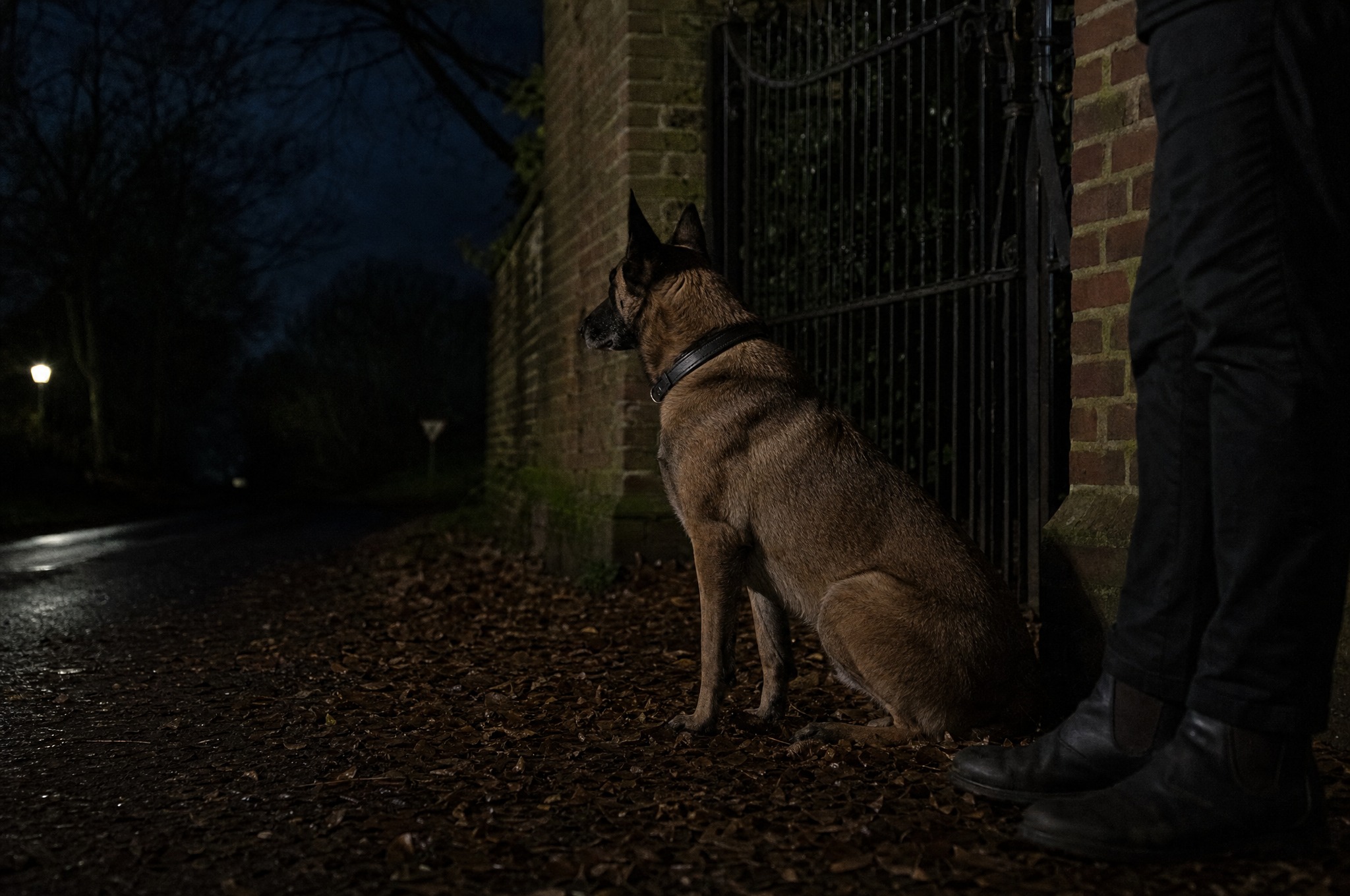
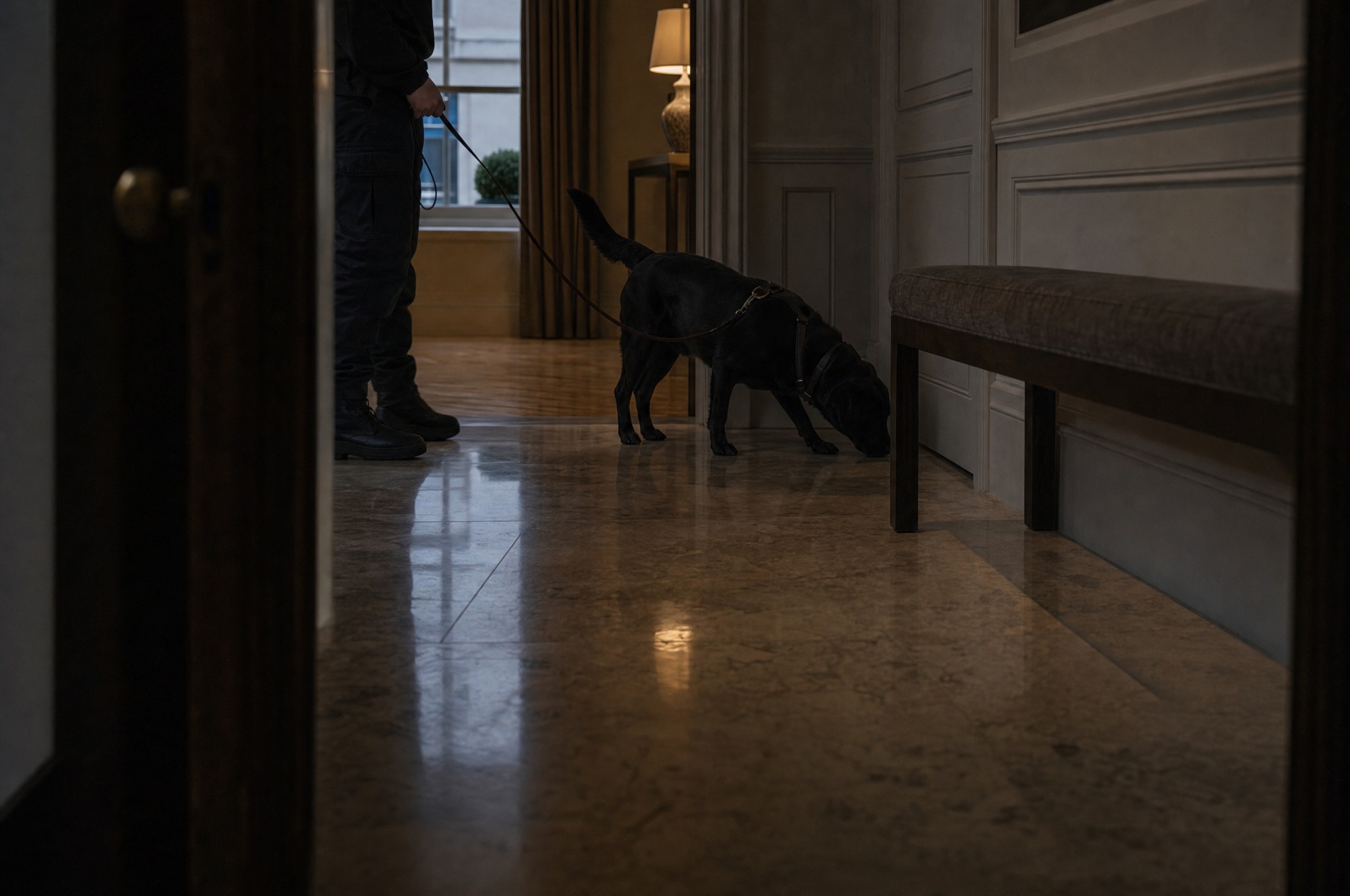
Guard dogs work with a handler to patrol and secure estates and residences with large grounds. They are also used to patrol and secure properties under renovation and homes left unoccupied for a period. In the United Kingdom their use is governed by the Guard Dogs Act 1975. A handler capable of controlling the dog must be present on the premises and in control of it. That presence and control are required unless the dog is secured so that it cannot roam freely. Whether or not the dog is secured, a warning notice must be displayed at each entrance. An arrangement that falls short of those conditions should not be relied upon.
Personal protection dogs live within a household and are trained to respond on command to protect its people. They suit principals and families who want a further layer of protection at home without a constant human presence. Temperament, the household's routine and the presence of children all have to be considered before a dog is placed. So does the commitment needed to keep the dog's training current once it is in the home.
Detection dogs search for specific substances. Depending on their training, that may mean explosives, firearms and ammunition, or controlled drugs. Searches are commonly made of residences before occupation, of vehicles and of venues ahead of a private event. Mail and deliveries are also commonly searched where there is reason for concern about them.
Quality varies widely across canine provision. British Standard BS 8517 sets out recommendations for general purpose security dogs in Part 1. Part 2 covers detection dogs, and the standard addresses handler training, welfare, kennelling and continued proficiency. Handlers deployed on guarding duties should hold the appropriate Security Industry Authority licence. Those are the measures against which any provider should be judged.
Integration is where most of the value lies. A dog patrolling a perimeter needs to be known to the household, its staff and any protective team. Its routes and timings have to fit the routine of the residence and the people in it. The handler needs to know who is permitted on site and what normal looks like. Where cameras and alarms are in place, the dog and handler answer what those systems detect. That shortens the time between an alert being raised and a physical check on the ground.
A detection dog searches for physical material. Searching for listening devices and concealed electronics is a separate discipline, technical surveillance.
The residence itself, its access, sightlines and staff, is assessed under residential protection, which usually includes canine cover.
For the client, canine security means an additional protective layer matched to the environment and the assessed risk. It works with the rest of the household's arrangements rather than sitting apart from them.
In practice this means guarding cover for grounds and perimeters that are otherwise hard to watch. It also means personal protection within the home where the threat warrants it, and detection searches. These take place ahead of occupation, travel or events, with dogs and handlers integrated into wider security planning.
Arrangements may be short term, for a single event, a property standing empty or a time of heightened concern. They may also be continuing, where a residence or principal warrants standing cover. Detection searches are usually arranged as single tasks before a specific occasion.
An arrangement begins with an assessment of the site and the requirement. From that assessment, the type of dog, the number of handlers and the hours of cover are agreed. The way the team will work alongside household staff is agreed at the same stage. Welfare and kennelling are planned as carefully as deployment, because a tired or poorly kept dog is less capable.
Private gatherings bring unfamiliar people and vehicles onto a site that is otherwise kept under control. The planning involved is set out in the briefing on private event and function security.
Country properties with long empty periods and regular contractor access are covered under residential protection in the Cotswolds.
A specific threat, as opposed to general exposure, is first examined under threat and risk mitigation. Any canine measure that is then recommended follows directly from the findings of that assessment.
All enquiries are treated with the utmost discretion and confidentiality.
Protect
Executive ProtectionDiscreet, intelligence led executive protection for private clients, principals and families, designed to reduce exposure and preserve freedom of movement without unnecessary visible presence.
Mitigate
Threat and Risk MitigationStructured assessment that identifies where exposure exists and reduces it through proportionate, targeted measures across people, places and routine.
Detect
Surveillance DetectionSurveillance detection identifies hostile interest and emerging patterns of activity, providing early warning of potential threats before targeting progresses to action.
Sweep
Technical SurveillanceTechnical surveillance that detects covert devices, unauthorised transmissions and technical compromise across residences, offices and sensitive environments.

Secure
Security ChauffeuringSecure movement delivered through trained protective drivers, considered route planning and continuous situational awareness.
Fortify
Residential ProtectionResidential protection for private homes and estates, drawing on assessment, access control and continuity to protect principals and families at home.
Respond
Close Proximity Response™A discreet, client carried alert and live location capability that lets a protective team maintain proximity and respond immediately, without an overt security presence.
Canine
Canine Security & DetectionSpecialist canine security encompassing guard dogs, personal protection dogs and trained detection teams, providing an additional layer of security and deterrence for people, property and sensitive environments.