
Discreet protective and intelligence support in Leeds. Coverage is shaped by the legal and financial district around Park Row and Wellington Place, the detached houses of north Leeds, the profile that cricket and football bring, and the daily corridor north towards Harrogate.
Leeds is the commercial capital of Yorkshire and one of the largest legal and financial centres outside London. Its professional district runs from Park Row and Park Square, where barristers' chambers and law firms occupy Georgian terraces, west to Wellington Place and the Whitehall Road blocks that house banks, accountants and national institutions. Wealth lives to the north. Alwoodley, Adel, Bramhope and Roundhay hold large detached houses on generous plots, and the villages along the A61 towards Harewood, Scarcroft, Shadwell and Linton hold the larger country properties of business owners, partners and sporting figures. Three golf clubs of national standing, Alwoodley, Moortown and Sand Moor, sit within a mile of each other on the northern edge, close to the Grammar School at Leeds. Headingley brings Test cricket and rugby league to a residential suburb, Elland Road brings Premier League football to the south of the city, and the arena draws touring acts to the centre. Leeds Bradford Airport is twenty minutes from the northern suburbs. Movement between home, city and the North Yorkshire country is by car and along a small number of roads, and that is where the pattern lies.
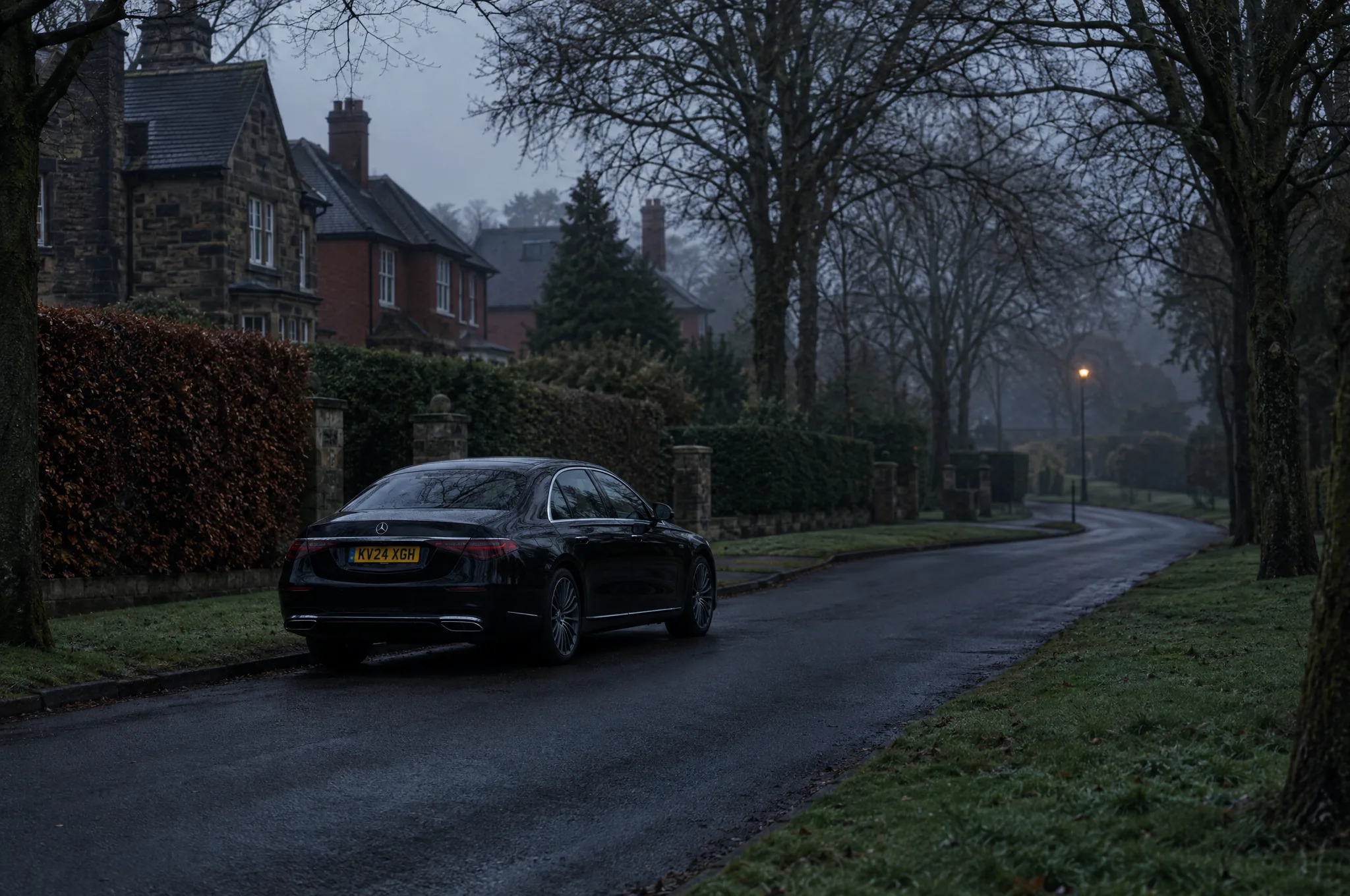
We work across the city and the northern corridor as one piece of ground. In the professional district the requirement is compact: offices, chambers and hotels within a few streets, and arrival and departure the moments that count. A single officer who fits a law firm's reception is the usual measure. In north Leeds the requirement is residential and vehicular. Houses in Alwoodley or Bramhope stand back from the road behind mature gardens, the boundary is long and the approach after dark is quiet, and the household leaves by the same road towards the same school or office most mornings. We assess the property and the commute together. For sporting principals we begin with the published calendar, since fixture lists at Headingley and Elland Road are known to everyone. Journeys north into the Dales and south to London are planned within the same arrangement.
Executive Protection accompanies barristers, financiers and business principals between Wellington Place, the courts and the northern suburbs, and sporting figures on fixture days.
Residential Protection is planned for the detached houses of Alwoodley, Adel, Bramhope and Roundhay and the villages towards Harewood, where long plots and quiet roads set the terms.
Security Chauffeuring covers the repeated journeys between north Leeds, the city, Leeds Bradford Airport and the Harrogate corridor that shape most households' weeks.
Leeds is a city of short distances and few roads. The professional district can be crossed on foot in ten minutes, and the northern suburbs are reached from it by two or three routes that every household uses.
That geography defines the work. In the centre the exposure is at doors: the pavement outside chambers on Park Square, the hotel entrance, the restaurant on a Friday evening. In the north it is the drive and the road, repeated daily, with school and office departures often meeting the A61 within the same half hour.
The northern suburbs are settled and affluent, and a large house on a quiet road in Alwoodley or Adel is known to its neighbours and to anyone who has looked. Boundaries are long, gardens are mature and the approach after dark is unobserved. Deliveries, gardeners and cleaners widen the circle of access.
Sporting profile runs through the city. Cricketers, footballers and rugby league players live in the north and travel to Headingley, Elland Road and the training grounds on schedules that are published or easily inferred, and their families are recognised in the same shops and schools as everyone else.
Work is kept low profile as a matter of course. Leeds is direct and observant, and an obvious protective presence would be discussed within the day.
The corridor north is the most repeated journey in most engagements, and the spa town at its end is covered under Harrogate. The residence itself is assessed under residential protection.
The sporting calendar sets most of it. Test matches and international cricket at Headingley fill a residential suburb for five days at a time, and Leeds United fixtures at Elland Road do the same for an afternoon, with the road network south of the centre affected for hours either side. Both are published well ahead.
Leeds Festival brings a very large crowd to Bramham Park over the August bank holiday, and the Great Yorkshire Show fills Harrogate and the roads between the two towns for three days each July. The arena programme concentrates in the autumn and winter.
Residentially the exposure follows the school year. Term time produces the most repetitive pattern in the north, and the summer produces empty houses for weeks at a time, when the requirement moves from the road to the property.
West along the M62, Manchester presents a similar mix of corporate and sporting profile at greater density.
Residential assessments in the north lead the enquiries, and they usually arrive after something has changed: a move, a period of press attention, or a delivery driver who asked one question too many. The finding is most often the road and the routine rather than the house.
Corporate work follows, concentrated in the professional district. Law firms and financial institutions ask for coverage of a principal during a contested matter, a transaction or an announcement, and for arrival and departure at offices and hotels.
Sporting families ask for match day and public appearance coverage, and for an assessment of a home that has become known.
Security chauffeuring is requested where a household repeats the same journey to the city, the airport or a school, and where a principal travels to London several times a month.
Technical examinations are corporate, usually around a boardroom or a dispute.
A number of enquirers have noticed a vehicle or a person more than once near a home in Alwoodley or Roundhay, and that is resolved through surveillance detection ahead of any other measure.
Households with a second property in the Dales or on the coast raise the rural question, and distances and warning time govern the assessment there.
All enquiries are handled discreetly and reviewed before engagement suitability is determined. Information should be limited to what is necessary to outline the matter. Where appropriate, further contact is arranged following review.

Protect
Executive ProtectionDiscreet, intelligence led executive protection for private clients, principals and families, designed to reduce exposure and preserve freedom of movement without unnecessary visible presence.
Mitigate
Threat and Risk MitigationStructured assessment that identifies where exposure exists and reduces it through proportionate, targeted measures across people, places and routine.
Detect
Surveillance DetectionSurveillance detection identifies hostile interest and emerging patterns of activity, providing early warning of potential threats before targeting progresses to action.
Sweep
Technical SurveillanceTechnical surveillance that detects covert devices, unauthorised transmissions and technical compromise across residences, offices and sensitive environments.

Secure
Security ChauffeuringSecure movement delivered through trained protective drivers, considered route planning and continuous situational awareness.
Fortify
Residential ProtectionResidential protection for private homes and estates, drawing on assessment, access control and continuity to protect principals and families at home.

Respond
Close Proximity Response™A discreet, client carried alert and live location capability that lets a protective team maintain proximity and respond immediately, without an overt security presence.