
Discreet movement and residential support in Gerrards Cross. Coverage is shaped by a commute to Marylebone of about twenty minutes, large houses on the Commons and the private roads to the south, and international families whose year is set by Heathrow.
Gerrards Cross grew from a heath on the Oxford road into one of the most expensive towns in the country, and the railway explains it. The Chiltern line station opened in 1906 and still puts Marylebone about twenty minutes away, and the town round it is a grid of broad avenues of large detached houses on generous plots. The East and West Commons lie at the centre, open land with the older houses standing directly on it, and the ground to the south and west along Camp Road, Fulmer Road, Dukes Wood Avenue and the lanes towards Fulmer and Hedgerley holds the largest properties, several on private roads. Bulstrode Park, the wooded estate on the south western edge, gives the town a country boundary. The A40 runs along the northern side towards Beaconsfield and Denham. The M40 at junction 1 and the M25 at junction 16 are minutes away, and Heathrow is under nine miles. Residents are senior executives, business owners, names from broadcasting and film, and international families drawn by the schools and the commute. Its residents keep to a timetable set by the train, and the timetable is visible to anyone on the platform.
Movement carries more weight here than in most residential towns. The station is central, and a principal who walks from a house on the Commons to the platform each morning is on public ground for the whole distance. We plan that walk, or replace it, and we plan the drive to the M40 and the M25 with the same care, varying what can be varied and covering what cannot. Residentially the houses are large, gated and staffed, and the survey concentrates on the gate, the boundary shared with the Commons or with open land towards Fulmer, and the access circle of cleaners, gardeners, drivers and contractors. Coverage is proportionate to a town where the roads are quiet: a driver who observes, an experienced officer at an occasion, a residential plan built on assessment, access control and continuity. International families who hold a house here and homes abroad are assessed together.
Security Chauffeuring covers the station drop for Marylebone, the M40 and M25, Heathrow and the school run, using a driver who knows which cars belong there.
Residential Protection around the Commons, on the private roads behind them and towards Fulmer treats the open ground and bridleways as the unwatched frontage.
Threat and Risk Mitigation reads the routine, the access list and the two states of a large house, observably empty in August and full at Christmas.
The commute defines Gerrards Cross. Fast trains reach Marylebone in about twenty minutes, and a principal who uses them leaves the same house, covers the same half mile and stands on the same platform at the same time on most working days.
That pattern is the exposure. The house end and the London end are fixed. The half mile between, the departure window and the choice between the train and the M40 are not, and variation within them is the first response.
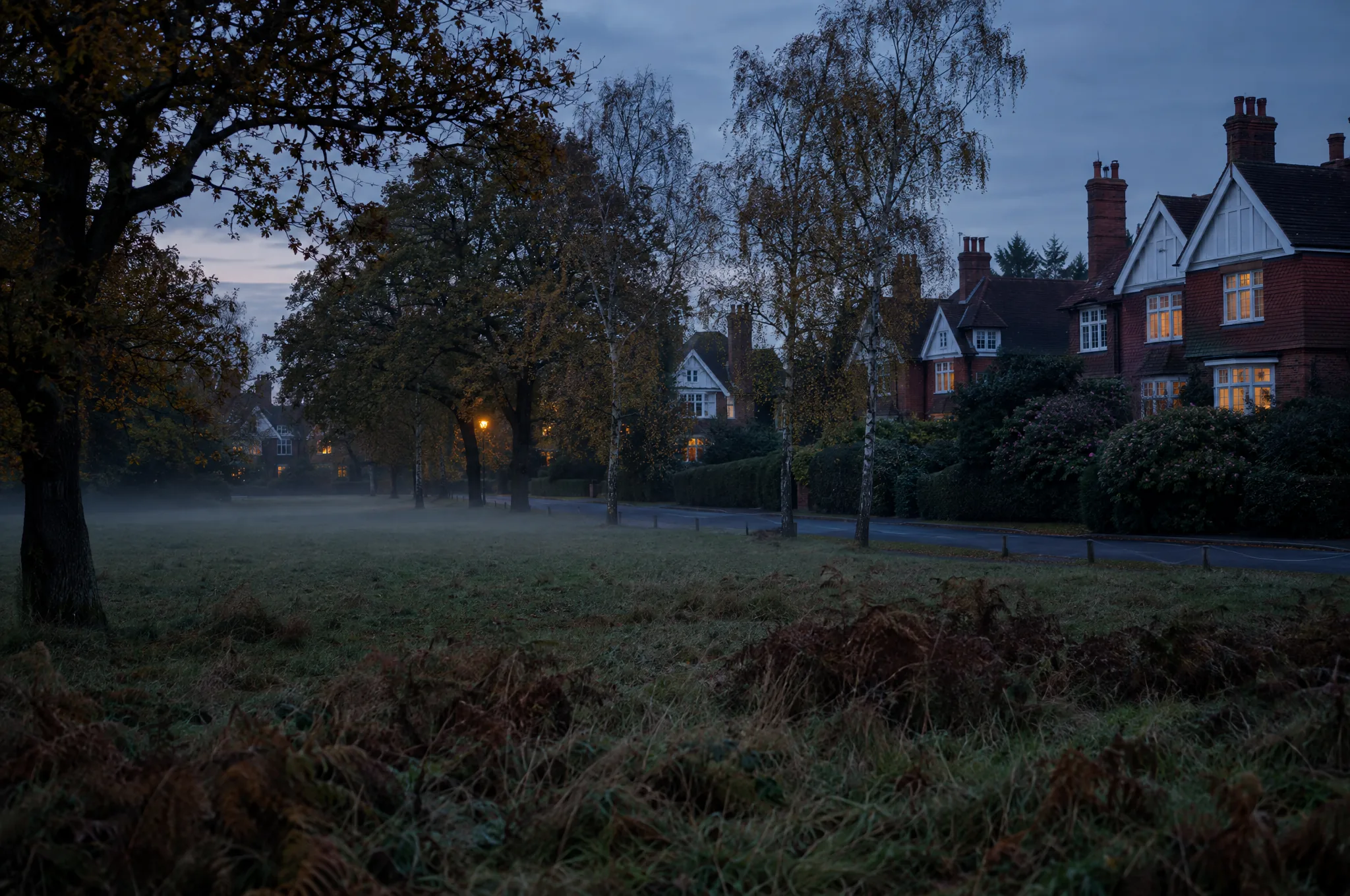
The Commons put open public ground against the oldest and largest houses in the town. A boundary that faces the common is a boundary that anyone can stand beside, in daylight with a dog and after dark without one.
South and west the plots grow and the lanes narrow. Camp Road and the roads towards Fulmer carry large houses behind gates and mature planting, several on private roads whose privacy is real but whose single entrance makes every vehicle on them noticeable.
Households here employ staff and use London contractors, and the access circle is often larger than the family thinks. It is written down and reviewed.
The town's international families add a second pattern: arrivals and departures through Heathrow, a house that is empty for weeks and full for days, and staff who hold keys through both.
Two miles north west the belt continues into Beaconsfield, larger and more spread out. Both are described within the wider Buckinghamshire picture, and the commute ends at Marylebone, where the London requirement begins.
Term time produces the tightest routine. The schools, the station and the M40 all draw on one gate in the same hour, and the pattern holds from September to July with breaks that empty the house.
For international families the exposure moves with the calendar. Arrival for the school year, departure for the summer and the weeks abroad in between are known in advance to staff, agents and schools, and the house is observably empty or observably full.
Winter evenings leave the Commons unlit against private boundaries from late afternoon, and the lanes towards Fulmer and Hedgerley carry little passing traffic.
Periods of raised profile, a transaction, an appointment, a public matter, raise the value of a readable commute more than they raise the threat. Movement to London, to Heathrow and across the county is covered under security chauffeuring during those periods.

Security chauffeuring is the first request and the most sustained. The station, the M40 and the M25, the school run and the Heathrow run are covered by a driver chosen for observation and continuity.
Residential assessment follows, most often for a house on or near the Commons or on one of the private roads to the south, and the finding households have considered least is usually the access circle.
International families ask for the house to be covered while they are abroad and for their return to be planned, with the airport treated as an extension of the residence.
A vehicle seen twice on a private road, or a person on the common who was there yesterday, is resolved through surveillance detection before the household changes anything.
Executive protection is asked for around a public matter, and is usually needed in London rather than in the town.
Technical examinations follow building works and staff changes.
Enquiries here frequently arrive through a family office or a private client lawyer in Mayfair, and less often from the household directly.

All enquiries are handled discreetly and reviewed before engagement suitability is determined. Information should be limited to what is necessary to outline the matter. Where appropriate, further contact is arranged following review.

Protect
Executive ProtectionDiscreet, intelligence led executive protection for private clients, principals and families, designed to reduce exposure and preserve freedom of movement without unnecessary visible presence.

Mitigate
Threat and Risk MitigationStructured assessment that identifies where exposure exists and reduces it through proportionate, targeted measures across people, places and routine.

Detect
Surveillance DetectionSurveillance detection identifies hostile interest and emerging patterns of activity, providing early warning of potential threats before targeting progresses to action.

Sweep
Technical SurveillanceTechnical surveillance that detects covert devices, unauthorised transmissions and technical compromise across residences, offices and sensitive environments.

Secure
Security ChauffeuringSecure movement delivered through trained protective drivers, considered route planning and continuous situational awareness.
Fortify
Residential ProtectionResidential protection for private homes and estates, drawing on assessment, access control and continuity to protect principals and families at home.

Respond
Close Proximity Response™A discreet, client carried alert and live location capability that lets a protective team maintain proximity and respond immediately, without an overt security presence.